Log in
You’ve Received Your Bill 16 Assessment: What Now?

Introduction
Your maintenance log and your contingency fund study are finally in your hands.
These documents are required by the Bill 16 regulation, which came into force on August 14, 2025, and they mark an important milestone for your condo: planning.
But many syndicates are asking the same question: so now what?
Should we start work? Raise contributions? Put out new calls for tenders?
This article walks you through this new phase: moving from assessment to action.
You’ll learn how to turn your reports into practical management tools, how to plan your work, and how to avoid the common mistakes that hold so many condos back.
1. Understand the scope of your assessment
Bill 16 aims to make building management more predictable and more professional.
Your maintenance log paints a technical picture of the building: its components, their observable condition, their useful life, and the recommended maintenance, upkeep work and major work.
The contingency fund study, for its part, translates all of this into figures: how much to contribute, when and why.
These documents aren’t just legal obligations: together, they form your condo’s master plan.
They help you see where the priorities are, plan upcoming work, set realistic budgets and, above all, protect the value and durability of your building.
2. Adjust your contributions: follow the assessment’s recommendations
Bill 16 doesn’t ask you to come up with a number on the fly: it requires that contributions to the contingency fund be set based on the recommendations of the study carried out by professionals. In other words, rely on the scenario recommended by your assessment, whether it’s a catch-up (a steeper increase at the start to make up for a shortfall) or a linear increase (a steady, predictable progression over time).
The board of directors’ role, from there, is very concrete: adopt this scenario, turn it into an annual budget and present it clearly to the co-owners.
In practice, the process has three steps:
- Read and endorse the study’s recommendation (chosen scenario, contribution levels, timeline).
- Build the scenario into next year’s budget: adjust common expenses according to the assessment’s recommendation.
- Prepare the presentation for the meeting: explain the why (condition of the components, risks avoided), the how much (annual contribution per unit) and the when (1-, 3-, 5- and 10-year horizon for the work).
Going through the meeting of co-owners isn’t just a formality: it’s the moment to build understanding and buy-in among co-owners.
The budget presented at the meeting is submitted for consultation: it lets the outgoing board explain the scenario recommended by the assessment and gather co-owners’ comments.
After that, it’s the new board of directors, elected at that same meeting, that officially adopts the budget and implements the contribution adjustments.
When the scenario is explained with concrete examples (the cost of a roof, the window replacement schedule, the savings achieved through preventive maintenance), co-owners better understand the logic of the plan and are much more willing to support the assessment’s recommendations.
3. Identify priority work
The maintenance log isn’t only for planning future replacements: it documents the building’s actual condition at the time of the inspection.
If the experts observed any anomalies, deficiencies or signs of wear, these should have been clearly communicated to you in the report. These findings let you quickly correct significant issues (for example, a cracked joint letting water in, an unstable guardrail or a clogged drain) before they turn into a costly loss.
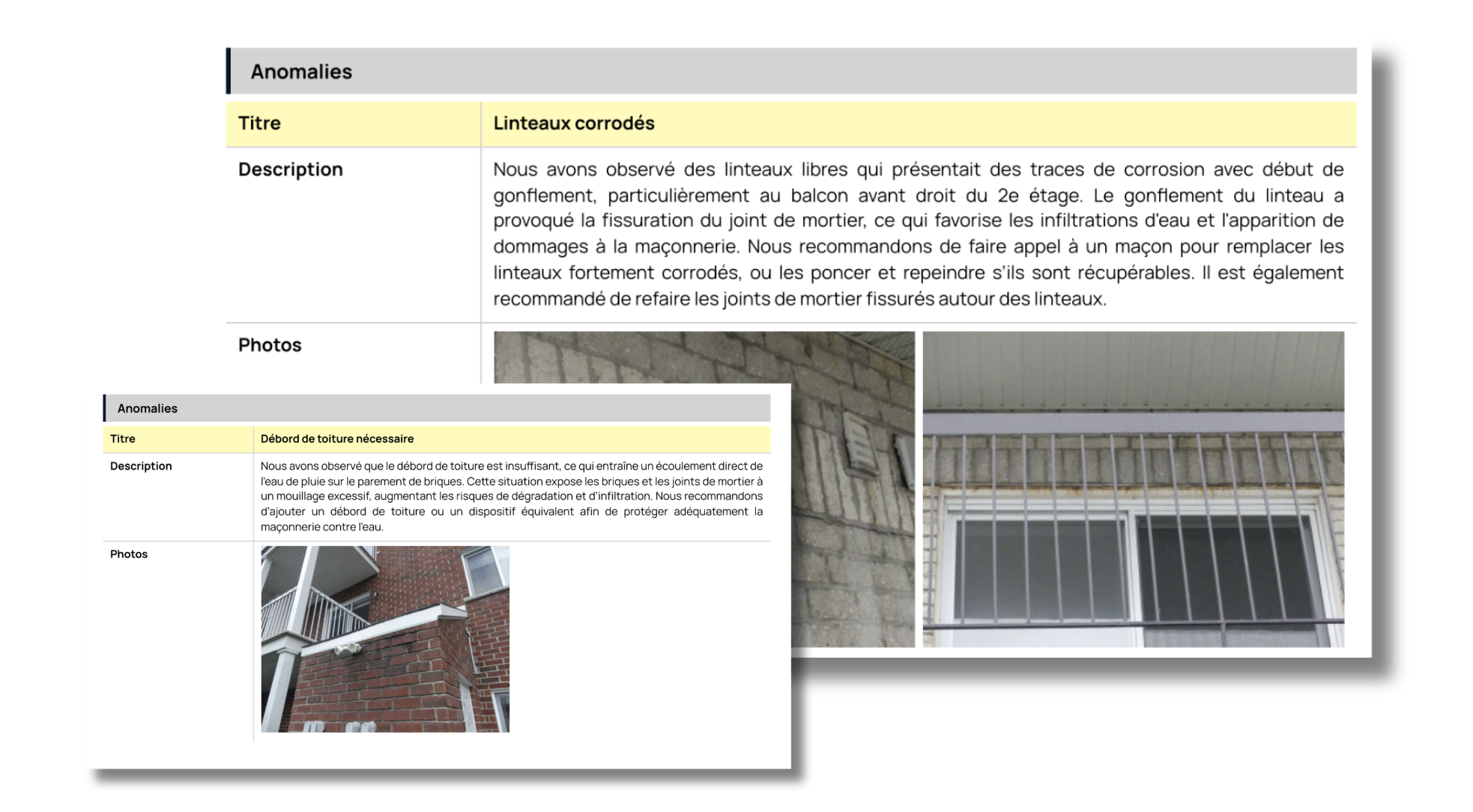 Examples taken from Regisco reports
Once these immediate fixes have been considered, you can organize your work according to three time horizons:
- Short term: regular maintenance, corrective repairs, preventive work or correction of identified deficiencies.
- Medium term: work planned according to the components’ estimated useful life (e.g. sealants, cladding, mechanical systems).
- Long term: major replacements and large-scale renovation projects (roof, windows, parking garage, etc.).
A good prioritization plan is based on occupant safety, the integrity of the building envelope and the replacement value of components. Items that pose a risk to the building’s safety, structure or watertightness should always be dealt with first, while preventive maintenance or cosmetic improvements can be planned for the longer term.
By combining the condition of the components observed in the maintenance log with the financial projections of the contingency fund study, the board of directors gets a clear, prioritized view of the actions to take, year after year.
4. Move from planning to action
Once priorities are set, the most concrete step begins: preparing and carrying out the work.
This is where many boards of directors feel out of their depth. Yet with a bit of method, everything becomes simpler.
a) Frame the project
Start by defining:
- the type of work;
- the objectives (renovation, maintenance, compliance);
- the target budget;
- the constraints (access, time of year, living alongside occupants).
b) Choose the right partners
For major work, it’s often necessary to consult a professional (engineer, architect, technologist).
They can prepare the plans and specifications needed for a clear, comparable call for tenders.
Always require:
- a valid RBQ licence;
- liability insurance;
- recent references;
- a detailed schedule and written warranties.
💡 Good to know: Regisco works in partnership with the team at RénoAssistance, a recognized network of vetted contractors across Quebec. This partnership aims to support syndicates in their renovation or major work projects by giving them access to:
- hand-picked contractors, checked for their experience, insurance and RBQ track record;
- neutral, free support in selecting, comparing and negotiating quotes;
- quality follow-up throughout the project, to ensure compliance and that deadlines are met.
By combining Regisco’s technical planning with RénoAssistance’s on-the-ground expertise, boards of directors get genuine end-to-end support, from the plan all the way to completion.
c) Monitor and document
During the work, schedule regular check-ins: site meetings, sign-off on key stages, schedule adjustments if needed.
At the end, carry out a formal acceptance: check the quality of the work, have deficiencies corrected and collect all important documents (warranties, manuals, photos, invoices and certificates). This information must then be added to the maintenance log.
This isn’t just good practice: the Bill 16 regulation specifies that the board of directors must keep the log up to date and update it at least once a year. In reality, it’s strongly recommended to update it as soon as any work is done, whether it’s maintenance, an inspection or a replacement.
Each addition makes your file more complete and your next contingency fund study more reliable. That’s how the cycle comes full circle: each action feeds the next, creating continuity in the building’s management.
💡 Good to know: Regisco simplifies this ongoing updating with an intuitive digital solution. You can record your work, add your invoices and photos, and automatically generate an up-to-date log, with no Excel spreadsheets and no information lost from one board term to the next.
5. Three common mistakes to avoid
- Letting the reports gather dust
Logs and studies are often seen as documents to be filed away. In reality, they are meant to be used every year. - Managing piecemeal
Issuing a call for tenders without defining the exact scope of the project leads to extras and conflicts. Take the time to frame the need before calling contractors. - Forgetting about communication
What co-owners fear most is the unknown. A clear schedule, posted in the lobby or sent by email, is often enough to ease concerns.
6. Good habits for effective management
- Keep all documentation: invoices, photos, warranties, inspection reports.
- Review your log after every piece of work.
- Plan by season: masonry before winter, roofing in spring, parking garages in summer.
- Update your syndicate’s certificate of condition (ASEC) after every major change.
In short, administrative rigour protects you as much as the concrete in your foundations.
7. A new management culture
Bill 16 marks the end of reactive condo management.
It introduces a culture of planning: know, anticipate, document.
With a well-prepared maintenance log and fund study, you have a technical and financial compass.
That’s what lets volunteer directors spend less time putting out fires and more time carrying out lasting projects.
Conclusion
Having your log and your study is a bit like having the map and compass for your condo.
The real difference lies in how you use them.
Plan, budget, document and communicate: those are the four pillars of effective management.
And if all this seems complex, Regisco was created precisely to make the job easier for you: a digital platform, tracking tools, support and automated updating of your log.
In summary
You now have the tools. With a little support, you can turn these obligations into a real source of value and peace of mind for your condo.
👉 Need help taking action?
Our experts support syndicates with planning, updating and coordinating work.
Visit regisco.ca/contactez-nous or try our platform at app.regisco.ca/register.
Choose peace of mind by making your condo management easier.
Start your 30-day free trial today. No commitment required, no credit card needed.
Try it for free