Log in
Complete Guide to Restricted Common Portions in Quebec Condominiums
Introduction
Welcome to the world of restricted common portions (RCPs): areas that are often misunderstood, yet essential to the smooth running of a condo in Quebec.
RCPs, the common spaces reserved for a single co-owner, are often at the root of misunderstandings and heated discussions between co-owners and directors.
This guide aims to shed light on this particular category of spaces. It will help you better understand what they are, their legal status, and the rules governing their maintenance, their replacement and how the related costs are shared.
To get started, it’s important to distinguish the different types of spaces found in a divided co-ownership. On one side are the private portions, which belong exclusively to one co-owner. On the other are the common portions, which are the undivided property of all co-owners. The common portions are further divided into two categories: general common portions (GCPs), accessible to everyone, and restricted common portions (RCPs), whose access or use is reserved for one or a few co-owners only.
Do you have a balcony, a parking space or a window that you consider “yours”, but that doesn’t really belong to you? In divided co-ownership, everything depends on clearly understanding what is strictly private, what is common to all, and what is common… but reserved for one person.
Understanding restricted common portions
Definition and context
1. General common portions (GCPs)
General common portions are the parts of the building that belong to all co-owners and are accessible to all occupants. No co-owner has exclusive use of them.
A few common examples:
- Roof, exterior walls, foundations
- Entrance lobby, stairways, corridors
- Shared systems (central heating, main plumbing, ventilation)
Who takes care of them?
- The condo syndicate is responsible for their maintenance, repair and replacement
- These costs are paid collectively through the general common expenses
2. Restricted common portions (RCPs)
RCPs are common portions whose use is exclusive to a single co-owner, who does not become their owner for all that. They are common spaces... that you alone get to use.
Typical examples:
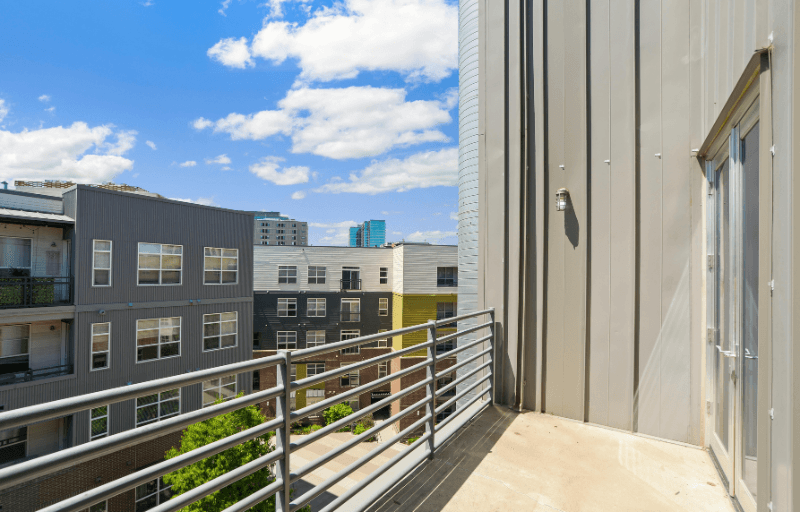
- Balconies, patios and terraces attached to a unit
- Private entrance doors, exterior windows associated with a unit
Who does what? It depends on what the declaration of co-ownership or the building by-laws say:
- Maintenance (cleaning, snow removal, small jobs): often the responsibility of the co-owner who uses the space
- Major repairs or replacement (for example, replacing windows or rebuilding a balcony): generally the syndicate’s responsibility, unless the declaration provides otherwise.
Legal nature
Even though their use is limited to a single co-owner, restricted common portions (RCPs) remain fully common portions within the meaning of the law. This means they can neither be sold nor altered without complying with the strict legal rules that govern common portions.
In short, enjoying the balcony, terrace or windows on your own does not make you their owner. The law strictly governs these spaces: it ensures they keep their common character, even when used exclusively. In other words, a right of use is not a right of ownership. Being the only one who enjoys the balcony… doesn’t mean it belongs to you.
The law makes sure that the collective interest comes first, even in the most exclusive corners!
Management and responsibilities
Role of the condo syndicate
The syndicate is responsible for the maintenance and preservation of the building and for the administration of the common portions.
Article 1039 C.C.Q. – Upon publication of the declaration of co-ownership, the co-owners as a body constitute a legal person whose objects are to preserve the immovable, to maintain and manage the common portions, to protect the rights appurtenant to the immovable or the co-ownership and to take all measures of common interest. The legal person must in particular ensure that the work necessary for the preservation and maintenance of the immovable is carried out.
It is called the syndicate.
Separate responsibilities under Bill 16
Since Bill 16 came into force, the Civil Code of Québec has clarified how responsibilities are shared.
In short, article 1064 establishes that:
- Co-owners with exclusive use of RCPs are responsible for their maintenance and routine repairs (minor)
- Major repairs and replacement of these portions are the syndicate’s responsibility and are financed by the contingency fund
The declaration of co-ownership may provide for a different allocation of the co-owners’ contributions to the costs of major repairs to restricted common portions and the replacement of those portions.
Finding your way: who does what for RCPs?
Even if you’re the only one who enjoys your balcony or terrace, that doesn’t mean you can (or must) maintain, repair or replace everything yourself.

It is therefore essential to distinguish between maintenance, routine (minor) repairs, major repairs and replacement.
Here are a few concrete examples to make it clearer:
- Maintenance — Cleaning the surface of a balcony, clearing snow from the steps of an outdoor staircase: simple, regular tasks, generally the responsibility of the co-owner who uses the space.
- Routine (minor) repairs — Tightening a wobbly railing, oiling the hinges of an exterior door, or repainting a section of guardrail: occasional but modest jobs.
- Major repairs — Repairing a significant crack in a balcony slab, replacing several balusters on a damaged railing, or replacing the hardware on an exterior door.
- Replacement — Completely redoing a balcony’s waterproofing membrane, replacing the entire guardrail, or replacing all the windows of a private unit.
Why a by-law is essential
Responsibilities aren’t always obvious… and they can vary from one condo to another. That’s why the syndicate should adopt a specific by-law that spells out:
- What each co-owner using the space must do (e.g. maintenance, small routine or minor repairs)
- What falls under the syndicate’s responsibility (e.g. major repairs, replacement)
This by-law becomes an indispensable management tool for avoiding misunderstandings… and conflicts!
This clarification is essential to avoid misunderstandings and to make sure the contingency fund properly accounts for RCP components in the study carried out by a professional.
The syndicate, for its part, is responsible for major repairs (e.g. replacing the membrane, structural repair of the slab) and for replacement at the end of the useful life, paid out of the contingency fund, unless the declaration of co-ownership states otherwise, which remains exceptional.
Co-owners’ rights and obligations
The co-owner who benefits from an RCP has the right to enjoy it exclusively, subject to the rules set by the condo. However, this exclusive right comes with obligations: keeping the space clean, repairing damage caused by misuse, and respecting the appearance and layout standards set by the syndicate.
Where can you find information about their use and maintenance?
Several documents set out the rights and obligations relating to RCPs.
1. Declaration of co-ownership
- Identification of the common and private portions
- Rules on use, maintenance and replacement
- Description of the restricted common portions (e.g. balcony, doors, windows)
2. Building by-laws
- Maintenance responsibilities (daily, seasonal, preventive)
- Rules for major repairs or replacement
- Permitted or prohibited behaviour (e.g. installing furniture, barbecues, plants)
3. Syndicate register
- Amendments or additions adopted at meetings of co-owners
- Resolutions on the allocation or maintenance of certain RCPs
4. Cadastral plan, certificate of location
- To pinpoint the location of RCPs
- To identify the physical boundaries between common, private and restricted common portions
Co-owner liability when an RCP is not maintained
A co-owner who causes damage to a restricted common portion (RCP) through a lack of maintenance, improper use or unauthorized work may be held liable for the cost of repairs or restoration.
For example, a co-owner who enjoys a rooftop terrace cannot demand that its replacement be fully covered by the syndicate if, over the years, it becomes clear that they failed to maintain it. In such a case, compensation could be claimed from them.
The declaration of co-ownership often clearly sets out the respective responsibilities of the syndicate and the co-owners for maintaining RCPs. It is therefore essential that every co-owner reads it and meets their obligations, to preserve the common portions and limit disputes.
Practical and legal aspects
Use and regulation
The use of RCPs is governed by the building by-laws. They may prohibit certain installations (barbecues, temporary shelters, etc.) or impose specific standards (materials, colours, maintenance). Following these rules is essential to avoid conflicts and keep the peace within the condo.
Assignment and sale of rights
A restricted common portion (RCP), such as a shed or a parking space, belongs to all co-owners, but its exclusive use is granted to a single co-owner.
You can lend (or rent out) the use of your space, but you cannot sell it separately from the condo unit it is attached to. In short, changing the use of an RCP is not a trivial matter: it affects how the building is organized collectively and must follow a formal procedure to be valid and to protect everyone’s rights.
Common versus private portions: the distinction and what it means
It’s important to distinguish a common portion from a private portion. The first belongs to everyone, the second to a single co-owner.
Common portions
Common portions are the parts of the building that belong collectively to all co-owners, in undivided ownership. They are essential to shared use, to the building’s operation or to its structure, and they can neither be sold nor altered without following the rules set out in the law.
Main characteristics:
- Undivided ownership by all co-owners
- Shared use or essential structural function
- Maintenance, repairs and replacement are the condo syndicate’s responsibility
- Their management is governed by the declaration of co-ownership and the Civil Code of Québec
Typical examples: Load-bearing walls, roof, foundations, stairways, corridors, entrance lobby, shared networks (main plumbing, electrical, ventilation)
Note: Common portions can be general (accessible to everyone) or restricted (reserved for one or a few co-owners, while remaining collective). Their nature and use are specified in the declaration of co-ownership.
Private portions
Private portions are the parts of the building reserved exclusively for a single co-owner, both in use and in ownership. They form a separate lot registered in the declaration of co-ownership and generally come with a share of the common portions.
Each co-owner holds full ownership rights over their private portion, which gives them the freedom to enjoy it, alter it (under certain conditions) and sell it, while respecting the condo’s rules.
Characteristics:
- Exclusive, private use
- Individual ownership
- Maintenance and repairs are the co-owner’s responsibility
Common examples:
- The inside of a unit (non-load-bearing walls, floors, ceilings, cabinets, etc.)
- A parking space or storage unit, when these are identified as private lots in the Declaration
The technical description (certificate of location) attached to the declaration specifies the exact boundaries between private and common portions. Some elements located inside a unit, such as windows or load-bearing walls, may therefore belong to the common portions or the restricted common portions.
Insuring private and common portions: shared responsibilities
Since Bill 141 came into force, the condo syndicate must insure not only the common portions, but also the private portions of the building. This coverage is for rebuilding the portions to their original condition, as defined in the declaration of co-ownership.
For their part, co-owners remain responsible for insuring their improvements, meaning any changes or additions made to their unit after its original construction (e.g. replaced floors, updated cabinets, renovated showers, etc.).
It is therefore essential, for both the syndicate and each co-owner, to document these elements properly. To that end, a key document, often called the Description of the private portions (reference unit), specifies the original materials, finishes and equipment used as the basis for determining what is covered by the syndicate’s insurance and what is covered by the co-owner’s.
Condo fractions and expenses
Beyond use and maintenance, RCPs raise important questions about how expenses are shared.
In the past, common expenses were allocated solely according to the relative value of the fractions. This uniform approach, while simple, didn’t account for differences in use or wear between the building’s various components. Today, with Bill 16 in force and contingency fund studies becoming the norm, a more precise method is called for.
Each co-owner must now contribute, through their payments to the contingency fund, to the cost of maintaining and replacing common components, including those of the restricted common portions (RCPs) assigned to them. These costs are planned according to each component’s estimated useful life in the contingency fund study.
To reflect this reality, syndicates now use two types of allocation keys:
- General common expenses (GCE): cover expenses that concern all co-owners (e.g. roof, structure, ventilation system).
- Special common expenses (SCE): apply to expenses that affect only certain co-owners, based on the use reserved for them (e.g. replacing a private balcony or a patio door)
The contingency fund study, required by Bill 16 and soon mandatory, must include all of the building’s components, including RCPs, to ensure predictable and sufficient funding for future work.
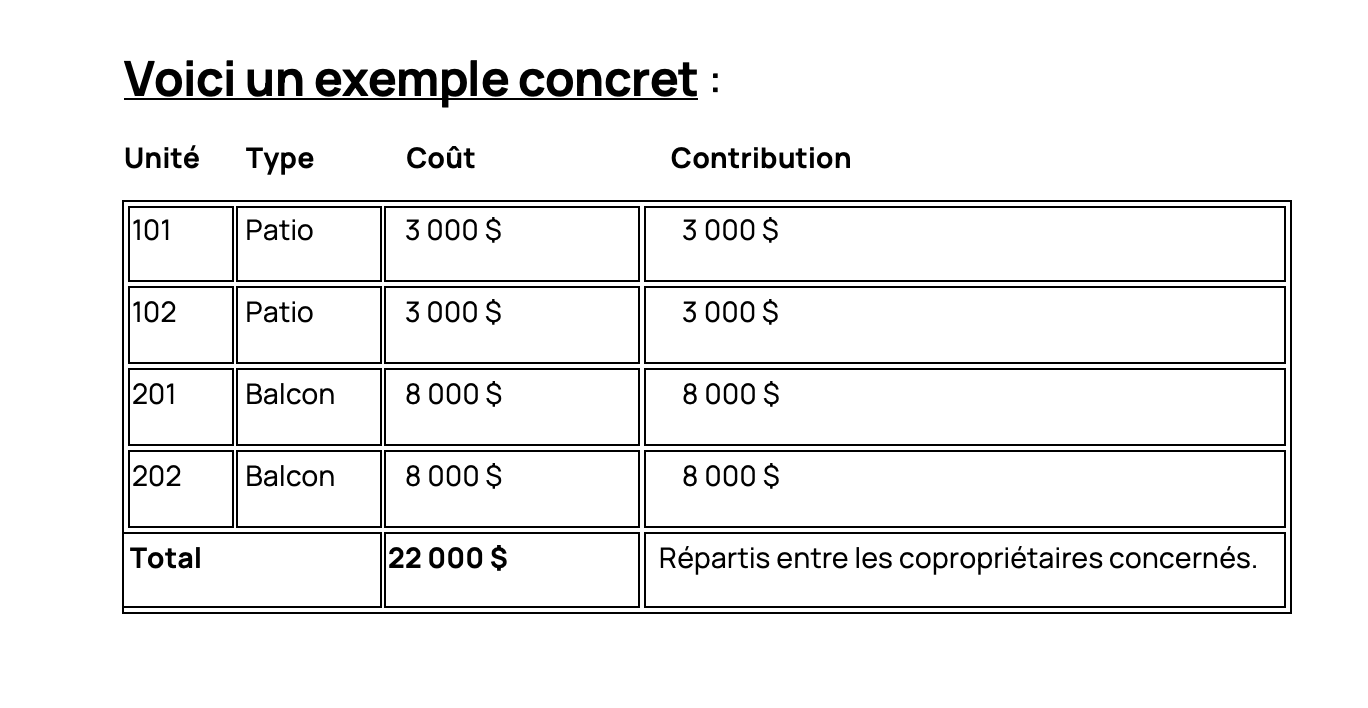
Key takeaway - Adjusting the allocation keys is mainly relevant when cost differences are significant. The goal is greater fairness, by taking into account the specific wear linked to the exclusive use of certain elements.
This method makes it possible to calculate, for each co-owner:
- A general contribution based on their share of the building
- A specific contribution based on the exclusive use of certain common components (balcony, door, stairway, etc.)
All in all, it’s a fairer and more rigorous approach that reflects the building’s actual situation. It also supports better financial planning, more accurate budgets and contingency fund studies that are better suited to real needs.
Finally, the decision to introduce separate allocation keys rests with the board of directors, often on the recommendation of the specialized firm hired to carry out the study. The firm takes into account the building’s characteristics and the declaration of co-ownership to design tailored allocations.
Tips and recommendations
Five good habits for friction-free management
-
Start by rereading the declaration of co-ownership: it contains all the key information about RCPs (even if it isn’t always crystal clear at first glance)
-
Keep the lines open: good communication between the board and the co-owners prevents a lot of headaches
-
Inspect regularly: an ounce of prevention is worth a pound of cure, especially when water gets involved
-
Consult a condo professional: declarations of co-ownership can contain grey areas. An expert can help you interpret them correctly and avoid mistakes
-
Set rules for the use of common portions, including RCPs: It’s essential to govern the use of common portions, including restricted common portions (RCPs), through clear, well-communicated by-laws
A good by-law prevents many nuisances: items stored haphazardly on balconies, non-compliant shelters or furniture, bulky or dangerous equipment, and so on.
For example, a by-law could prohibit storing tires, unsecured barbecues or plastic storage bins on terraces or balconies. It could also require seasonal installations, such as planters or awnings, to meet certain appearance and safety criteria.
Such rules help not only preserve the building’s visual harmony, but also limit the risk of damage, complaints or conflicts between co-owners.
Conclusion
Managing RCPs is a bit like tending a shared garden: everyone has their own little corner to look after, but the balance of the whole depends on everyone’s effort. With rigour, transparency and a good spirit of collaboration, these spaces can become a strength for the condo rather than a source of tension.
Managing restricted common portions depends on a careful reading of the declaration of co-ownership and a sound application of the Civil Code of Québec. Even when use is exclusive, maintenance and preservation are a shared responsibility. That’s why rigour, clarity and respect for the rules are essential.
The board of directors plays a key role: making sure expenses are shared fairly, according to the rules in force or those yet to be established. Structured, transparent management helps prevent misunderstandings, build trust between co-owners and maintain a harmonious living environment.
Choose peace of mind by making your condo management easier.
Start your 30-day free trial today. No commitment required, no credit card needed.
Try it for free