Log in
Plan ahead to invest: major work and strategic investments

This article looks at the investment opportunities available to syndicates and shows how the new obligation to plan for major work makes it easier to adopt better investment strategies.
Introduction
Since the Civil Code of Québec came into force in 1994, syndicates of co-owners have had to set up a contingency fund to finance major repairs and the replacement of the common portions. However, many syndicates have not properly funded it, often due to a lack of information and awareness. The minimum contribution of 5% of the annual budget proved insufficient, and in some cases funds were diverted to other purposes. This poor management left contingency funds too low, forcing co-owners to pay unexpected special assessments.
To address these challenges, the government introduced Bill 16, opening the door to investment strategies, since syndicates can now better anticipate major work and manage their finances more effectively.
Modern, effective management
Managing a contingency fund follows the same principles as personal financial planning: anticipate future needs, save regularly and invest wisely.
To ensure a building’s long-term durability, a syndicate must build up a sufficient financial reserve (the contingency fund) and make the most of it through secure investments.
Although the draft regulation on the contingency fund study is not yet in force, syndicates are advised to adopt best practices now so they’re ready to comply with future legal obligations. Several companies offer a contingency fund study service and set up a maintenance log: Regisco is one example.
Legal framework of the contingency fund
Since 1994, article 1071 of the Civil Code of Québec has required condo syndicates to fund a contingency fund used exclusively to finance major repairs and the replacement of the common portions.
The adoption of Bill 16 (2019) and Bill 31 (2024) brought major reforms, including the obligation to carry out a contingency fund study and to set up a maintenance log. From 2025, once the draft regulation is adopted, syndicates will have to plan their future contributions and expenses carefully and comply with that plan.
Legal obligations for investments
The syndicate must stick to investments presumed sound, in accordance with articles 1339 to 1344 of the Civil Code of Québec. Article 1341 specifies that the money must be deposited with a recognized financial institution and be repayable on demand or on notice of no more than 30 days, unless the deposit is fully guaranteed by the Autorité des marchés financiers (AMF).
Because they must now prepare a complete asset management plan, syndicates can forecast major inflows and outflows of money with a certain degree of accuracy.
This clearer financial picture allows them to adopt a more proactive and better-tuned investment strategy. However, every investment must still strictly comply with the legal framework in force, which guarantees the security and liquidity of the funds invested.
Investment strategy for a contingency fund
Let’s take the example of a building syndicate that has built up $150,000 in its contingency fund.*
1. Recommended types of investments
The fund must be invested in low-risk financial instruments that meet the legal requirements:
- High-interest savings accounts **(**for immediate liquidity).
- Guaranteed investment certificates (GICs).
- Guaranteed savings bonds.
2. Approval by the board of directors
The board must:
- Analyze the investment options and make sure they comply with the law and the declaration of co-ownership.
- Document its decisions in the meeting minutes.
- Consult a financial professional to get the most out of the fund.
3. Allocating investments for a $150,000 fund
Example of a fictional situation for a 16-unit building that is 10 years old:
- Liquidity: $50,000 in a high-interest savings account, to cover immediate needs according to the contingency fund study.
- Short-term investment: $50,000 in cashable GICs, offering a minimal return (about 3%) and quick access if needed.
- Medium-term investment: $50,000 in non-cashable GICs to maximize returns safely (about 4%).
For a very small syndicate (duplex, triplex, etc.), the ideal would be to combine a high-interest account to keep cash available for short-term needs with, when possible, laddered GICs to secure a stable return. The amounts invested will be more modest, but the strategy remains an effective way to manage the contingency fund safely.
With this new regulation, contingency funds should see some growth in the coming years, notably because of the obligation not only to carry out a contingency fund study but also to pay in the required contributions.
4. Management for large syndicates with significant assets
Let’s take the example of a $350,000 contingency fund. The basic strategy would remain similar, but with a longer-term investment for the $150,000 surplus, for a total of $200,000 more to invest:
- Liquidity: $50,000 in a high-interest savings account to cover immediate needs.
- Short-term investments: $50,000 in cashable GICs offering a minimal return (about 3%) and meeting liquidity needs.
- Medium-term investments: $50,000 in bonds and/or non-cashable GICs to maximize returns safely (about 4%).
- Longer-term investments: $200,000 and up: the syndicate could invest a larger share in instruments offering a higher return, such as principal-protected notes, while meeting its legal obligations.
For these investments and any additional amounts available ($200,000 and up), it’s advisable to consult a wealth management advisor or a Chartered Financial Analyst (CFA) for specialized management.
Note: In this example, the information on the principal-protected note was provided by Antoine Vézina of Invia Gestion Financière, a Desjardins partner, with initial capital of more than $200,000*. Another group consulted for this exercise,* La Financière (National Bank), requires initial capital of more than $500,000 and offers several types of investments.
5. Investment management options
Syndicates of co-owners have two main options:
- Financial institutions: For investments up to $200,000, a bank or credit union (caisse) offers simplicity, security and accessible advice, although returns may be limited.
- Investment dealers: For larger investments, a broker can provide access to a wider range of investments and better returns, but this requires closer oversight and checking that the broker is registered with the AMF.
Conclusion
With the new obligations coming into force, a proactive approach is essential. The asset management plan will become indispensable for planning work, estimating costs and structuring long-term financing. This tool makes financial decisions more transparent and reassures co-owners that the syndicate’s finances are being managed soundly. In addition, the investment choices made for the contingency fund will have a direct impact on the level of contributions required.
Experts like Regisco already offer, in their reports and technology tools, suitable investment strategies that give boards of directors what they need to make informed choices based on each syndicate’s specific needs.
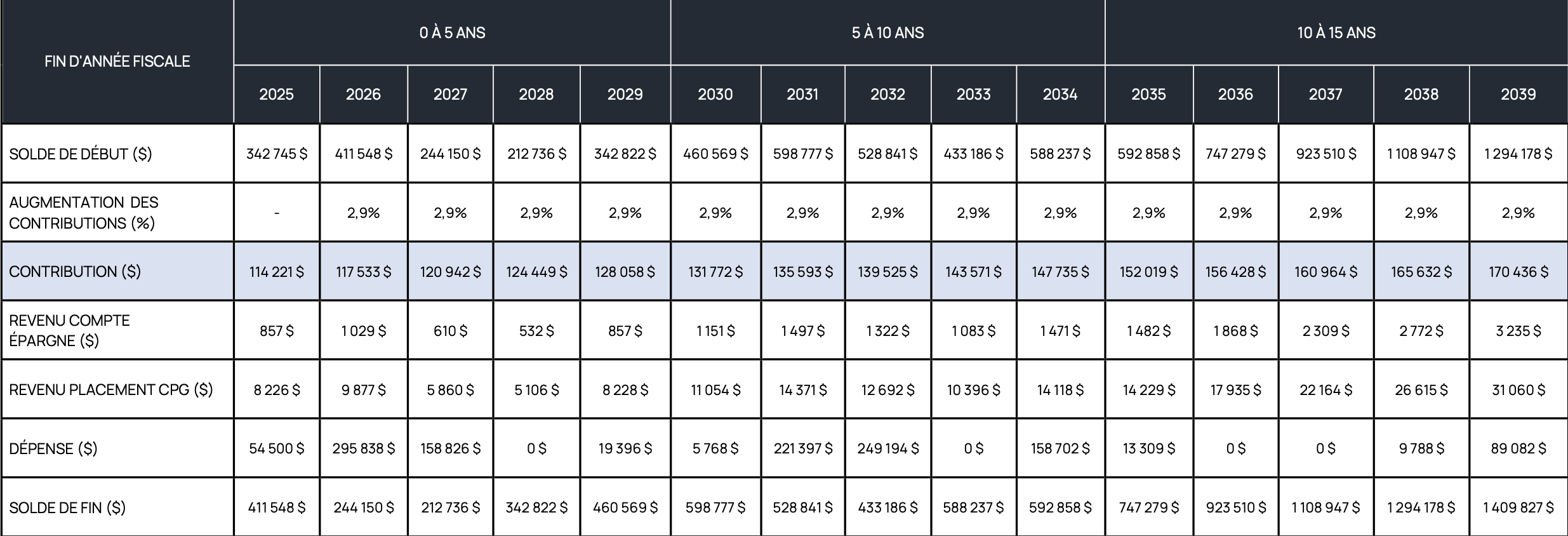 Example of a contribution strategy with investments from a Regisco report.
Yet in Quebec, nearly 40% of syndicates don’t have the right tools to fund their contingency fund properly, which often leads to imbalances between generations of co-owners.
To get the most out of a condo’s contingency fund, it’s essential to innovate and look for new, suitable investments. However, these investments must comply with all the laws in force, particularly regarding liquidity and the security of the capital.
By favouring low-risk and principal-protected investments, syndicates of co-owners can safeguard their real estate assets over the long term while minimizing financial surprises.
Wise, proactive management is the key to a secure and stable future for all co-owners.
Note that it’s essential for each syndicate to consult a professional to make sure its investment choices meet the legal requirements and its specific needs.
The Regisco Team
Choose peace of mind by making your condo management easier.
Start your 30-day free trial today. No commitment required, no credit card needed.
Try it for free