
 Log in
Contingency fund study in Quebec City
Preserve the value of your buildings in Quebec City, Lévis and the Capitale-Nationale region with our specialized contingency fund study and custom maintenance log services.
Get a free quote
Annual contribution to the contingency fund
 $14,512
A turnkey service.
Every mandate we take on follows a rigorous support process designed to meet the needs of your condo. Discover why more than 350 clients have chosen to trust Regisco.

Integrated solution
With our digital tool, your data becomes dynamic and adaptable. Take control of your budget planning!
Flat rate
Enjoy reduced rates on bundled offers, mandate revisions and combined services.
Tailored approach
We support you at every step of the project, and we remain available after the mandate to answer your questions.
Support
Our team specializes in condos. We understand the issues you deal with every day.
Report quality
We designed a report that is clear, easy to understand and compliant with industry best practices.
Building experts
A study carried out entirely by engineers and technologists who are members of a professional order.
The steps of a mandate with Regisco’s professionals
Step 1
We send you an online questionnaire to gather the information needed for the mandate: declarations of co-ownership, various expert reports, building plans, history of work done, financial statements, etc.

Step 2
Within 2 to 6 months, an expert visits your condo to inspect the building’s common areas, as well as one or two private units.

Step 3
The syndicate receives the report within a maximum of 90 days. At the client’s request, a meeting with an expert can be arranged to discuss the results (at no charge).
Mandates completed in the region of Quebec City
Our team has completed several mandates in the region, notably for vertical and horizontal (initial) syndicates, and we can also help you with commercial building mandates.
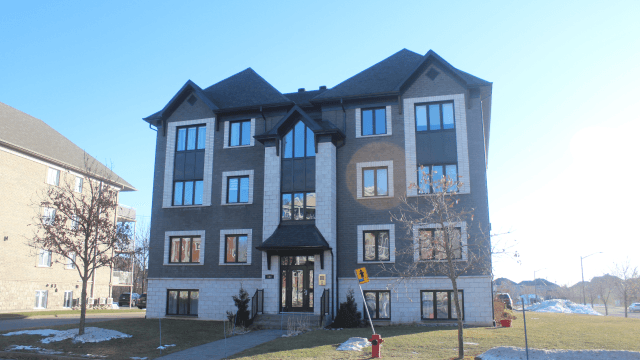
SDC 500 Douvain
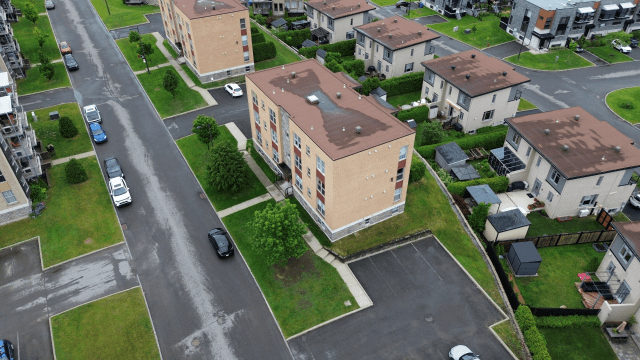
SDC Anne-Martin 222
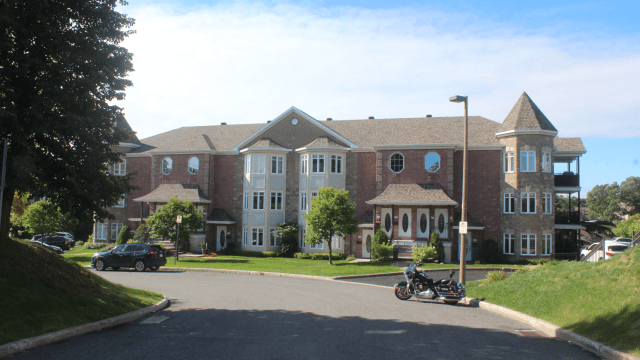
SDC Domaine des Diamants

I had the pleasure of working with Regisco on the contingency fund studies of several condo buildings in Montreal. A young, dynamic and very professional company. Thank you to Kayci for supporting us throughout this project!
 Zachary RoyGestior
Regisco carried out the contingency fund studies of several buildings we manage (buildings ranging from 33 to 119 units). In every case, the report provided was professional and of high quality.
 Émilie AubinSentinel
Our syndicate of co-owners worked with Regisco for our contingency fund study and we are very pleased with the service in terms of speed, communication and value for money. I recommend them to any syndicate looking to work with a young, dynamic team at the cutting edge!
Elliot BeaumierEDV Phase 8 AdministratorMake your quote request today.
Free and no obligation.
Frequently asked questions
Find answers to the most frequently asked questions.
A contingency fund study is a methodical analysis that determines the amounts to pay in each year to cover major repairs and the replacement of the common portions of a condo building. It establishes an inventory of the components, estimates their useful life and replacement costs, then produces a contribution schedule adapted to the syndicate’s financial situation. This long-term planning prevents financial surprises and preserves the property’s value.
The Civil Code of Québec (article 1071) requires the syndicate to establish its contingency fund based on the estimated costs of major repairs and the replacement of the common portions. Contributing only a percentage of the common expenses does not meet this requirement, since the resulting amount does not reflect the building’s real needs. Since the regulation of Bill 16 came into force on August 14, 2025, all syndicates must have a contingency fund study carried out by authorized professionals to determine the right contributions.
The regulation of Bill 16 came into force on August 14, 2025. Condo syndicates have three years, until August 14, 2028, to obtain a first compliant contingency fund study. The study must then be updated every five years by an authorized professional.
The regulation of Bill 16 reserves the contingency fund study for two groups of professionals: members of the Ordre des ingénieurs (OIQ), the Ordre des technologues professionnels (OTPQ), the Ordre des architectes (OAQ) or the Ordre des évaluateurs agréés (OEAQ) whose work mainly involves real estate management, construction, renovation, appraisal or inspection; and members of the Ordre des comptables professionnels agréés (CPA). In every case, the professional must be independent of the syndicate. At Regisco, every study is carried out by engineers and technologists who are members of their respective orders.
Each type of professional brings a different perspective:
- Engineers: specialized in civil engineering, construction or building mechanics, they assess the technical condition of the building's components, estimate repair and replacement costs, and help set long-term financial needs.
- Professional technologists: their hands-on experience carrying out and managing construction projects is valuable for estimating the cost of repair and replacement work.
- Architects: they bring an overall view of the maintenance and repair needs of the common portions, and recommend the work to be done.
- Chartered appraisers: they analyze the value of the common portions and the expected costs of maintaining and replacing them. They are not, however, specialized in building inspection; for that part, a building expert is often the better choice.
- Chartered professional accountants: their strength is the financial side, meaning the fund projections and the calculation of contributions. For the condition of the building's components, they rely on the maintenance log.
Whatever their title, choose a professional with condo experience. The skills to look for:
- in-depth knowledge of buildings;
- financial skills to produce accurate, fact-based projections;
- a solid understanding of condominiums, for example the ability to interpret the declaration of co-ownership.
The cost of a contingency fund study depends on the number of units, the size of the building and the complexity of the components to assess. Regisco offers a flat rate, with discounts on bundled offers, mandate revisions and combined services.
The contingency fund is used exclusively for major repairs and the replacement of the building’s common portions. The self-insurance fund, also introduced by Bill 16, covers insurance deductibles and uninsured losses.
The report includes a detailed inventory of the building components, an estimate of replacement costs, an assessment of useful lives and a contribution schedule over a horizon of at least 25 years. At Regisco, the report is signed by a professional who is a member of a recognized order and is designed to be clear and accessible to co-owners.
The maintenance log records the history of the work carried out and plans the routine maintenance of the building’s common portions. The contingency fund study focuses on long-term financial planning for major repairs and replacements. Both documents are mandatory under Bill 16.
A syndicate that does not have a compliant contingency fund study will not be able to provide the certificate required when a unit is sold, which could delay or jeopardize real estate transactions. The board of directors could also be held liable for failing to plan the finances.
Yes, the regulation of Bill 16 applies to all divided co-ownerships in Quebec, with no exception based on the number of units or the size of the building. Regisco supports small syndicates and large condos alike, with an approach adapted to each situation.
Once the contingency fund study is received, the board of directors has 30 days after the annual meeting to set the contributions according to the report’s recommendations. If the fund is insufficient, the syndicate has up to 10 years to make up the shortfall.
Yes, Regisco offers combined services for the contingency fund study and the maintenance log, with a reduced rate for bundled mandates. This integrated approach lets syndicates meet all of their Bill 16 obligations in a single mandate.
These three tools are often confused. The asset management plan is the umbrella term that brings all three together: the maintenance log, the building condition certificate and the contingency fund study. Directors use it to operate the building and ensure its long-term durability.
The building condition certificate is a separate mandate: a snapshot of the physical condition of the components at a specific point in time, based on a comprehensive inspection. The contingency fund study, on the other hand, puts a price on the upcoming major work and the amounts to accumulate to pay for it. These definitions follow the standard of the Regroupement des gestionnaires de copropriété du Québec.
A study is based on two mandates. The first is the inventory of components. The professional carries out a general inspection of the building to list the components and their theoretical useful life, following the Uniformat standard recommended by the RGCQ to standardize studies.
The second mandate is the financial projection, made over a horizon of at least 25 years, sometimes 40 years. It takes into account the replacement plan, the inflation rate and investment income to give a picture of the fund’s future inflows and outflows. The results of this projection are then used to build the syndicate’s financial strategies.
The contingency fund pays exclusively for major repair or replacement work on the common portions. Article 1152 of the Civil Code of Québec defines a major repair as an exceptional expense involving a significant part of the property, for example beams and load-bearing walls, roof replacement, retaining walls, or heating, electrical and plumbing systems.
This is different from the operating fund, which covers routine maintenance expenses such as window washing, janitorial services and minor work.
The replacement cost is the amount needed to replace a component at today’s value. Estimating it is the step with the greatest impact on the study’s results. The professional considers five elements: the quantity or area to be replaced, the level of effort specific to the building (such as height or confined space), administration and profit, professional fees, and applicable taxes.
Three methods are commonly used: field experience, a cost guide adapted to the Quebec market, and effort-based calculation. A quote from a certified professional remains the most accurate method.
The inspection carried out for the inventory of components is different from the comprehensive inspection of a building condition certificate. For an older building, it can be hard to trace the replacement history of components, and some may have passed their theoretical useful life without having reached the actual end of their life.
In these cases, a building condition certificate confirms the actual condition of the components and sets new useful lives, which makes the study’s results more reliable.
Still have questions?
Write to us or schedule a virtual information session with our team today.
